
Amazing Geography Facts | Life Map Insights
Look at a world map. Some countries are huge. Some are tiny. Some borders are straight lines. Others twist and turn like a river. Have you ever asked — why?
Most people look at texas map every day. But very few people understand what maps are really telling us. Every border has a story. Every shape has a reason. Every country is the way it is because of history, nature, and people.
Welcome to Life Map Insights. This is the place where maps come to life. Here, you will learn amazing facts about countries, borders, cities, and the world. You will read things that sound impossible — but are completely true.
Whether you love history, or you are just curious about the world, this website is for you. Get ready. The world is stranger and more amazing than you think.
Geography is More Than Just Maps
Most people think geography is just about maps and capitals. But geography is so much more than that.
Geography is the study of the Earth. It tells us why people live where they live. It explains why some countries are rich and some are poor. It shows us why wars were fought in certain places. It helps us understand why cities grew near rivers and oceans.
Think about it this way. The Himalayas are the tallest mountains in the world. Because of these mountains, India was protected from invasions for thousands of years. That is geography changing history.
Or think about Egypt. It is mostly desert. But the Nile River runs through it. Because of that one river, one of the greatest civilizations in history was born. That is geography creating life.
Geography is the story of our planet. And once you start reading that story, you cannot stop.
10 Geography Facts That Sound Fake But Are True
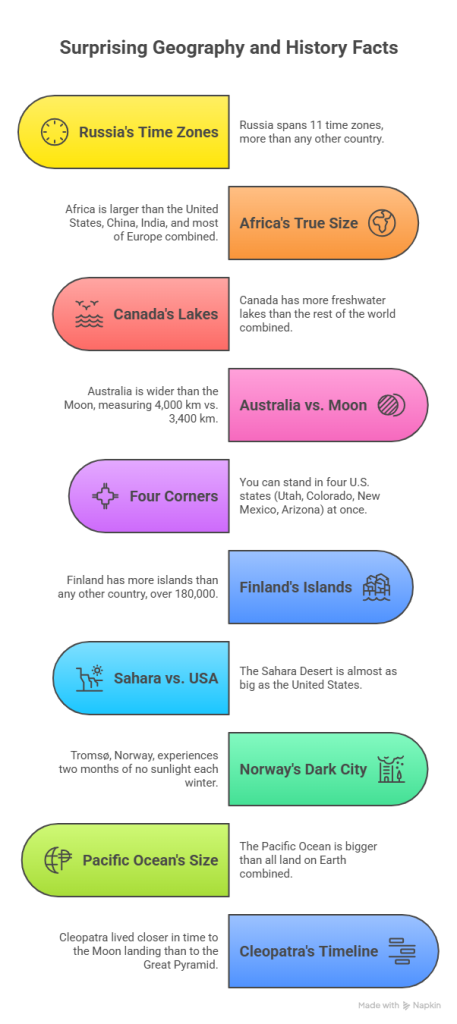
These facts are 100% real. But they will make you say — wait, is that actually true?
1. Russia has 11 time zones. Russia is so big that when it is morning in one part, it is already night in another part. No other country in the world has 11 time zones.
2. Africa is bigger than you think. Africa is larger than the United States, China, India, and most of Europe — all combined. But on most maps, Africa looks small. That is because old maps were not drawn to show the correct size.
3. Canada has more lakes than the rest of the world. Canada has about 60% of all the freshwater lakes on Earth. That is more lakes than every other country put together.
4. Australia is wider than the Moon. The Moon is about 3,400 kilometers wide. Australia is about 4,000 kilometers wide from east to west. Australia wins.
5. There is a place where you can stand in four U.S. states at the same time. It is called Four Corners. You can stand in Utah, Colorado, New Mexico, and arizona map all at once.
6. Finland has more islands than any other country. Finland has over 180,000 islands. That is more than any other nation on Earth.
7. The Sahara Desert is almost as big as the United States. The Sahara is the largest hot desert in the world. It covers about 9 million square kilometers. The USA is about 9.8 million square kilometers.
8. Norway has a city that gets no sunlight for two months. In Tromsø, Norway, the sun does not rise at all during winter. People live in darkness for about two months every year.
9. The Pacific Ocean is bigger than all land on Earth. All the continents put together are smaller than the Pacific Ocean. It covers more than 165 million square kilometers.
10. Cleopatra lived closer in time to the Moon landing than to the building of the Great Pyramid. The Great Pyramid was built around 2,500 BC. Cleopatra lived around 30 BC. The Moon landing was in 1969 AD. This is a geography and history fact that always surprises people.
Why Are U.S. States Shaped So Differently?
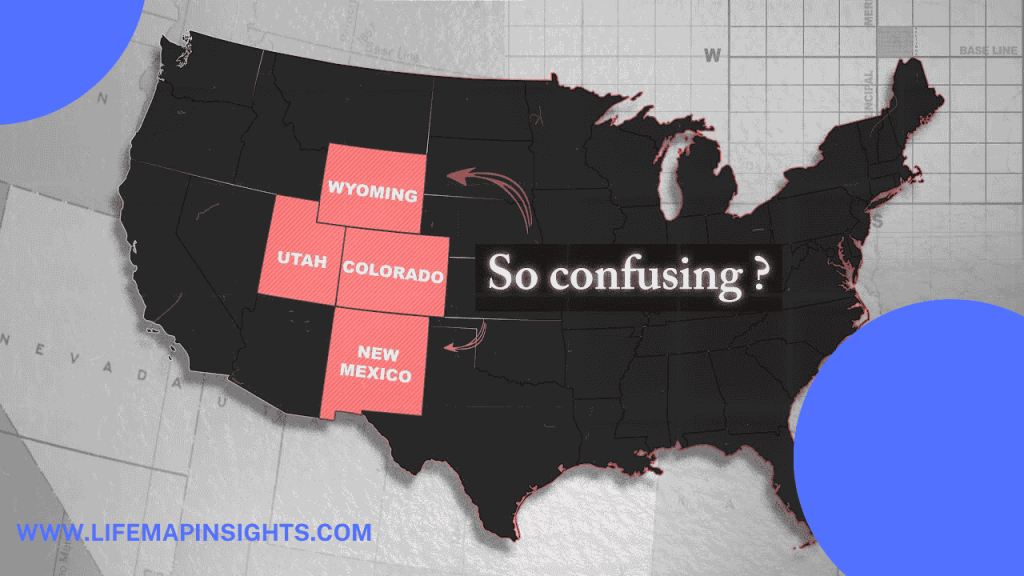
Look at a map of the United States. Some states are perfect squares. Others have strange shapes with weird edges. Have you ever wondered why?
The answer is simple — history and geography together created these shapes.
The straight-line states like Colorado and Wyoming were created in the 1800s. At that time, the land was mostly empty. The government just drew straight lines on a map. It was quick and easy.
The curvy-border states like Tennessee and Missouri have borders that follow rivers. Rivers were the natural roads of early map of south america. So borders were drawn along rivers like the Mississippi and the ohio map.
Texas is huge because it was once its own independent country. When it joined the United States in 1845, it kept its large size.
Alaska map is the biggest state of all. map of alaska It is more than twice the size of Texas. But it is separated from the other states by Canada.
Hawaii map is the only state that is a group of islands in the middle of the Pacific Ocean.
New York map is the only state in the U.S. that serves as a global gateway, connecting the world’s economy through a single iconic map.
The Virginia map reveals a unique geography, stretching from the sandy beaches of the Atlantic to the misty peaks of the Blue Ridge Mountains.
Every state has a story. Every shape has a reason. And once you know those reasons, the map of America starts to make perfect sense.
These Country Borders Will Surprise You
Some country borders are the strangest things on Earth. Here are a few that will make you look at the map twice.
Lesotho is a small country that is completely inside South Africa. It is surrounded on all sides by another country. There are only two other countries in the world like this — Vatican City and San Marino, both inside italy map.
The India-Bangladesh border used to be one of the most complicated borders in the world. There were small pieces of India inside Bangladesh. And small pieces of Bangladesh inside India. These were called enclaves. Imagine living in a tiny piece of your country, surrounded by a foreign country on all sides.
The Baarle-Nassau border between Belgium and the Netherlands is incredibly strange. The two countries are mixed together in a small town. Some houses are half in Belgium and half in the Netherlands. The border line runs through buildings, streets, and even restaurant tables.
The Diomede Islands are two small islands. One belongs to Russia. One belongs to the United States. They are only 3.8 kilometers apart. But because of time zones, they are 21 hours apart in time. People call them Tomorrow Island and Yesterday Island.
Borders are not just lines on a map. They are the result of wars, agreements, and history. And some of them make absolutely no sense — until you learn the story behind them.
Which Country is the Biggest? Which is the Smallest?
Let us compare countries by size, population, and other interesting facts.
By Land Size:
- Biggest: Russia — 17.1 million square kilometers
- Second: Canada — 10 million square kilometers
- Third: United States — 9.8 million square kilometers
- Smallest: Vatican City — only 0.44 square kilometers
By Population:
- Most people: China and India — both over 1.4 billion people
- Least people: Vatican City — only about 800 people
By Shape:
- Chile is the longest and thinnest country. It is 4,300 kilometers long but only about 177 kilometers wide on average.
- The Gambia is almost completely surrounded by Senegal. It is shaped like a long, thin finger.
Surprising comparison: The city of Tokyo in Japan has more people than the entire country of Canada. One city. More people than a whole country.
Geography teaches us that size does not always mean power. And small countries can have big stories.
How Geography Changed the Course of History
Geography and history are always connected. The shape of the land decided where civilizations grew, where wars were fought, and which countries became powerful.
Mountains as protection: The Alps mountains protected Rome for a long time. Enemies found it very hard to cross the mountains and attack. Geography was Rome’s natural wall.
Rivers as highways: The Nile, the Amazon, the Ganges — great civilizations grew along rivers. Rivers gave people water, food, and a way to travel and trade.
Oceans as power: Britain is a small island. But because it is surrounded by the ocean, it became a great sea power. The British navy sailed the world and built one of the largest empires in history.
America’s geography and power: The United States is protected by two oceans — the Atlantic and the Pacific. It has the Rocky Mountains in the west and the Appalachian Mountains in the east. It has the Mississippi River running through the middle. This geography made America one of the safest and richest nations in history.
Geography did not just shape borders. It shaped the entire story of human civilization.
5 Quick Map Facts That Will Blow Your Mind
- The shortest war in history lasted only 38 to 45 minutes. It was between Britain and Zanzibar in 1896.
- There is a town called “Nothing” in Arizona, USA.
- The city of Istanbul in Turkey is in two continents — Europe and Asia.
- If you dig a hole straight through the Earth from Spain, you come out near New Zealand.
- The Amazon River pushes so much fresh water into the Atlantic Ocean that you can find fresh water 200 kilometers away from the shore.
Your Geography Questions — Answered Simply
Q: What is the smallest country in the world? Vatican City is the smallest country. It is inside the city of Rome, map of italy. It is only 0.44 square kilometers. About 800 people live there.
Q: Why do some countries have straight borders? Straight borders were usually drawn by rulers on a map — not by nature. This happened a lot in Africa and the American West. Colonial powers and governments drew lines without thinking about geography or local people.
Q: Why is the world map not accurate? Most world maps use something called the Mercator projection. It makes countries near the poles look bigger than they really are. That is why Greenland looks almost as big as Africa on most maps. But in reality, Africa is about 14 times bigger than Greenland.
Q: Which country has the most neighbors? China and Russia both share borders with 14 other countries. That is more than any other nation in the world.
Q: Is geography still important today? Yes — very much. Geography affects trade, politics, wars, climate, and culture. Understanding geography helps us understand the news, history, and the future.
Start Exploring the World With Life Map Insights
The world is full of surprises. Every map has a secret. Every border has a story. Every country has a fact that will make you stop and think.
You have just read a small sample of what geography can teach you. And this is only the beginning.
At Life Map Insights, we bring you the most amazing, surprising, and easy-to-understand geography facts every week. We cover U.S. geography, strange borders, country comparisons, world history, and so much more.